


About Us
Get to know us better...-
Environmental
Respect and work for... -
Products
From Manufacturer... -
References
Some examples... -
Contact Us
keep in touch...
Colbond Solutions
ENKAMAT
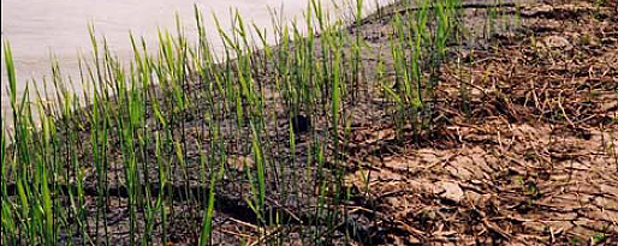
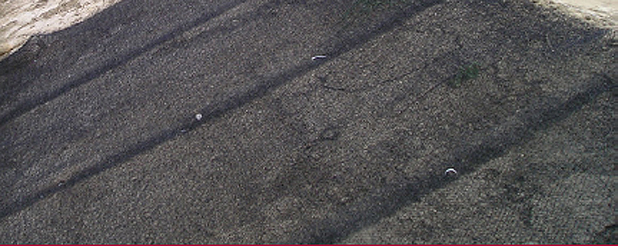
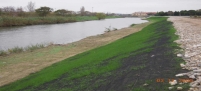
Enkamat is a flexible three-dimensional mat for immediate, permanent erosion protection on the most varied slope types. The open Enkamat product types are particularly suitable for use on steep dry slopes exposed to wind and rain and hence prone to erosion. Open Enkamat's artificial root structure with up to 1,800 m filament per m² creates an artificial root structure preventing soil eroding from steep slopes, river banks, landfill containments and other vulnerable areas.
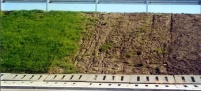
As a general rule, once laid on slopes, Enkamat is seeded and filled with humus or fertile soil. Vegetation can then take root and develop easily, because of Enkamat's artificial root structure protecting the soil and germinating seed.
Although it works to best effect when filled, there are some conditions in which Enkamat can be left unfilled. To ensure full contact with the soil surface, Enkamat should always be pegged to the surface of the slope. Enkamat will not degrade in soil, making it the right system solution for protecting slopes permanently against erosion. These anti-erosion mats come in rolls 1.0 m, 1.95 m, 3.85 m and 5.75 m wide.
Working with "plants as construction materials", all products from the Enkamat family provide effective integrated permanent erosion protection. Enkamat's artificial root structure provides new vegetation with the stable platform it needs to survive and develop, even under the most adverse conditions.
Even before vegetation develops, Enkamat offers immediate protection against erosion. The mat structure reduces the impact of wind and water on the surface, so preventing soil runoff.
ARMATER
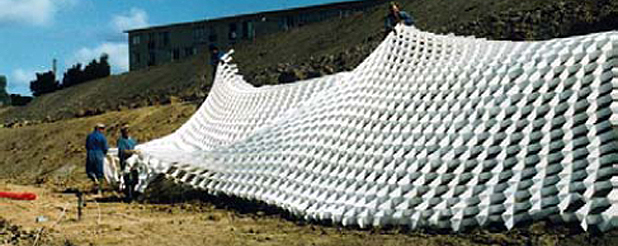
Armater has been specially designed for use on sub-bases which do not generally allow the growth of vegetation due to their geological properties. Slag heaps and rocky slopes are examples of this kind of sub-base, upon which a 10 cm thick layer of soil can be applied into Armater to form the basis for the development of vegetation.
In such cases, the honeycomb structure of Armater allows the mat to be filled with topsoil, providing a lasting grip in the cascading geocells. A further major application of Armater are slopes where the topsoil would erode, if no corresponding measures were taken to combat erosion. Armater is a flexible geocell made of geotextile fabrics connected to each other reciprocally to form a hexagonal honeycomb structure. The resulting cells can be filled with fertile topsoil, sand, flint or gravel, depending on the specific application.
The factors of rigidity and permeability are decisive criteria in the selection of the geotextile fabric used for the production of Armater. They are taken into account to ensure that the finished product can ideally fulfil the requirements of its specific application. The number of anchoring pins of Armater is determined by a great variety of parameters.
A great variety of plant species can be seeded into the Armater geocells to achieve fast growth and attractive greenery of the slope concerned. In addition to its functional characteristics, one of the benefits of Armater is its high degree of flexibility. The geocells can follow the gradient of the slope without buckling or warping. Furthermore, the lightweight material allows quick and easy installation.
The geocells are resistant to rotting and therefore stabilize the covered surfaces permanently, independent of the vegetation that has been chosen. Armater is also effective when filled with coarse or poor soil, which is unsuitable to support vegetation. However, any vegetation will improve the efficiency.
The high tensile strength of Armater ensures that the whole system has a high level of tolerance against the wide variety of strains that it has to tackle from the installation stage. The rigidity of the geotextile fabric prevents buckling during topsoil filling. The installation of Armater allows to grow vegetation on sub-bases, such as cut rocky slopes, which were originally unable to support the growth of vegetation. The filled geocells do that way keep such surfaces secure over a long period of time.
PRODUCTS
DOCUMENTS
- Enkagrid MAX 40
- Enkagrid PRO 60
- Enkagrid PRO 90
- Enkagrid PRO 120
- Enkagrid PRO 180
- Enkagrid TRC 30
- Enkagrid Installation Guidelines
- Armater RC20-20/10
- Armater Product Brochure
- Design Guide Armater
- Enkagrid MAX 20
- Enkagrid MAX 30
- Enkamat 7010
- Enkamat 7018
- Enkamat 7020
- Enkamat J
- Enkamat 7220
- Enkamat A20
- Intron Certificate, NL BSB certificaat Colbond
- Enkamat 7010W
- Enkagrid PRO 40
- EnkaGrid Family Brochure
PRODUCTS
HEAR FROM US


